
Two art walking tours in the Alpes-de-Haute-Provence, led entirely in English by Luc Richard — state-certified French mountain leader and mountain art guide certified by the Musée Gassendi. The 8-day Refuge d’Art hike (€1,690) with two nights spent inside Andy Goldsworthy’s sculptures, or the 6-day Chemins d’Art tour (€1,590) based in one country-house hotel. Both begin at Aix-en-Provence TGV station and end with a full day at Château La Coste. Groups of 5 to 10.
24 to 31 May and 3 to 8 June 2027, with an October departure to follow.
Contents
- A collection of contemporary art unlike any other
- Refuge d’Art: Andy Goldsworthy’s most ambitious work
- Two ways to walk it
- The 8-day Andy Goldsworthy hike, day by day
- The 6-day hotel-based tour, day by day
- Château La Coste: the counterpoint
- Your guide
- What previous guests say
- Everything is taken care of from the moment you arrive
- Prices and what they include
- Dates and availability
- Private departures
- Getting here
- Frequently asked questions
A collection of contemporary art unlike any other in the world
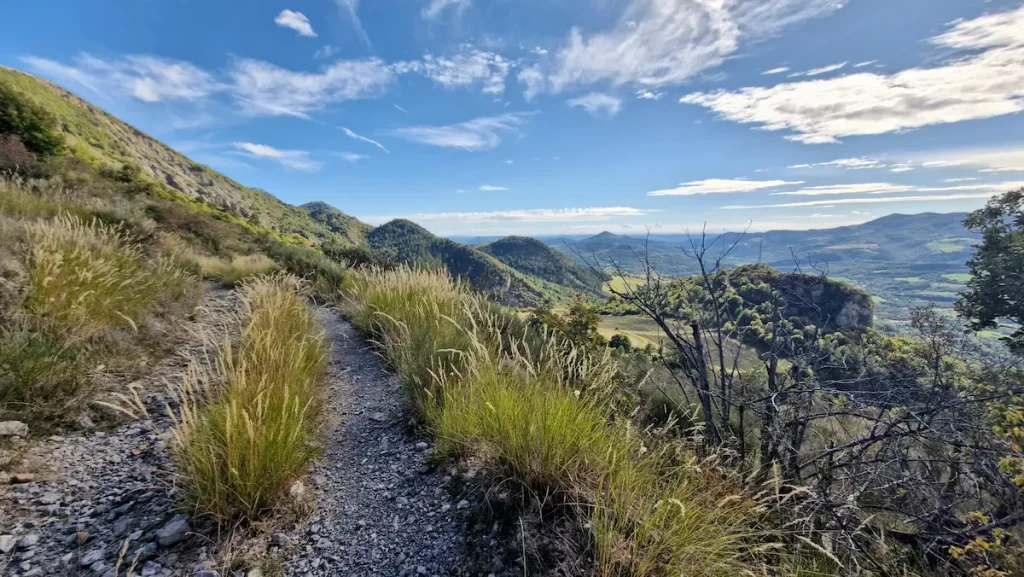
There is a stretch of southern France that almost nobody walks. It lies where Provence begins to climb into the Alps: two thousand square kilometres of black marl ridges, beech woods, abandoned hamlets and dry riverbeds, sparsely populated, poorly served by roads, and — for reasons that have everything to do with a handful of stubborn people — home to roughly a hundred works of contemporary art.
The story begins in 1994 with an invitation. The Musée Gassendi, in Digne-les-Bains, asked the British sculptor Andy Goldsworthy to come and work in the mountains above the town — and what began there ended up pushing a small provincial museum out of its own walls. Other artists came too, making work in the landscape itself: permanent, site-specific, unguarded, unlit, unsigned. Thirty years on, carried forward ever since by the museum’s team, that first invitation has produced the Collection d’Art en Montagne: a body of work spread across the Haute-Provence UNESCO Global Geopark with no walls, no opening hours and no queue.
The guiding idea comes from the philosopher Pierre Gassendi, born here in 1592, who gave the museum its name and the project its motto: ambulo ergo sum — I walk, therefore I am. The museum means it literally. These works show themselves only to people who have walked them, and nobody else.
In 2023 the Pôle Ambulo — the Musée Gassendi, the Maison Alexandra David-Neel and the Cairn art centre — was designated a Centre d’art contemporain d’intérêt national by the French state.
Refuge d’Art: Andy Goldsworthy’s most ambitious work
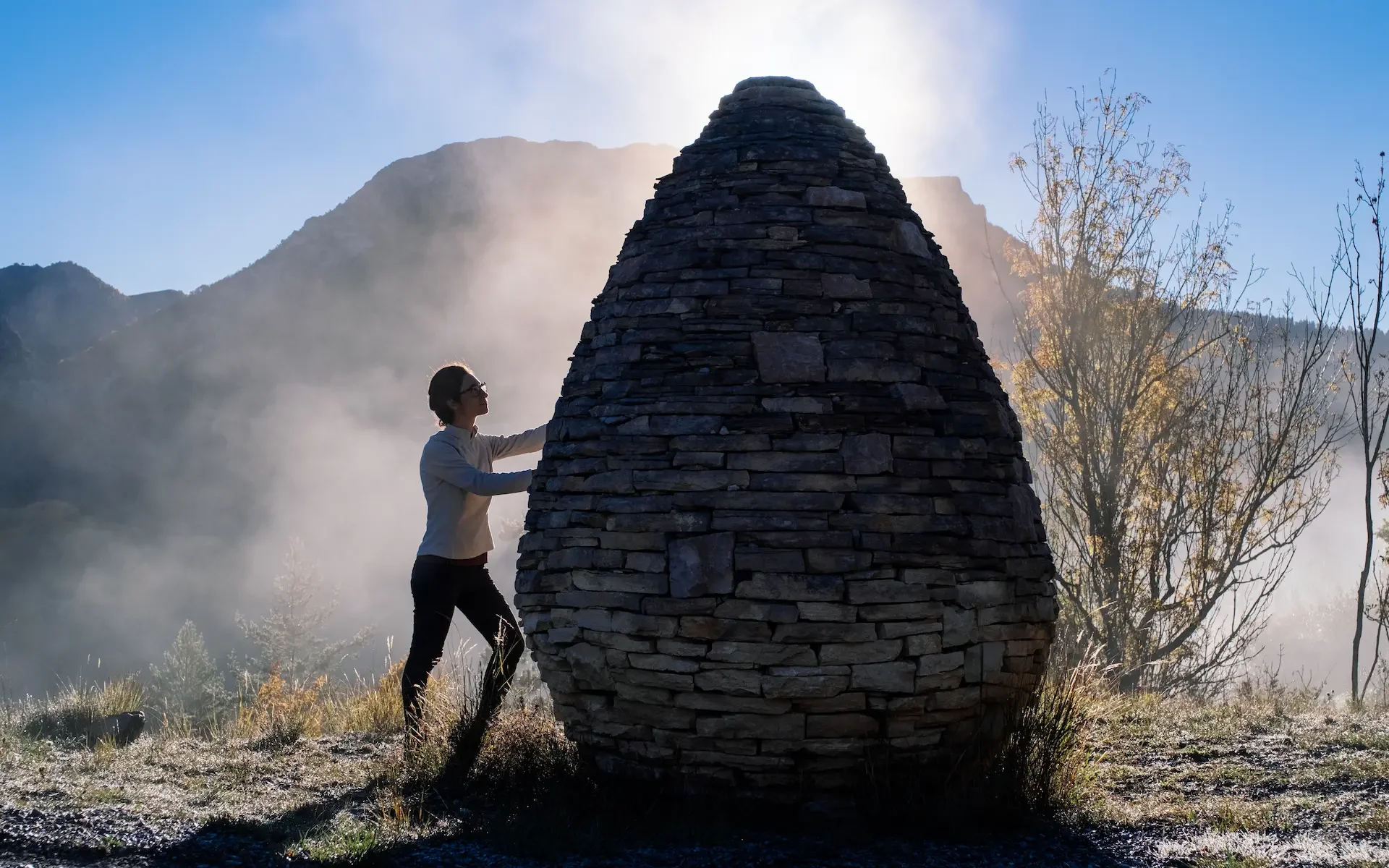
Of all the artists who came here, the British sculptor Andy Goldsworthy stayed longest and went furthest. Over nearly two decades he built Refuge d’Art: a single, continuous work of art that unfolds along 150 kilometres of mountain path.
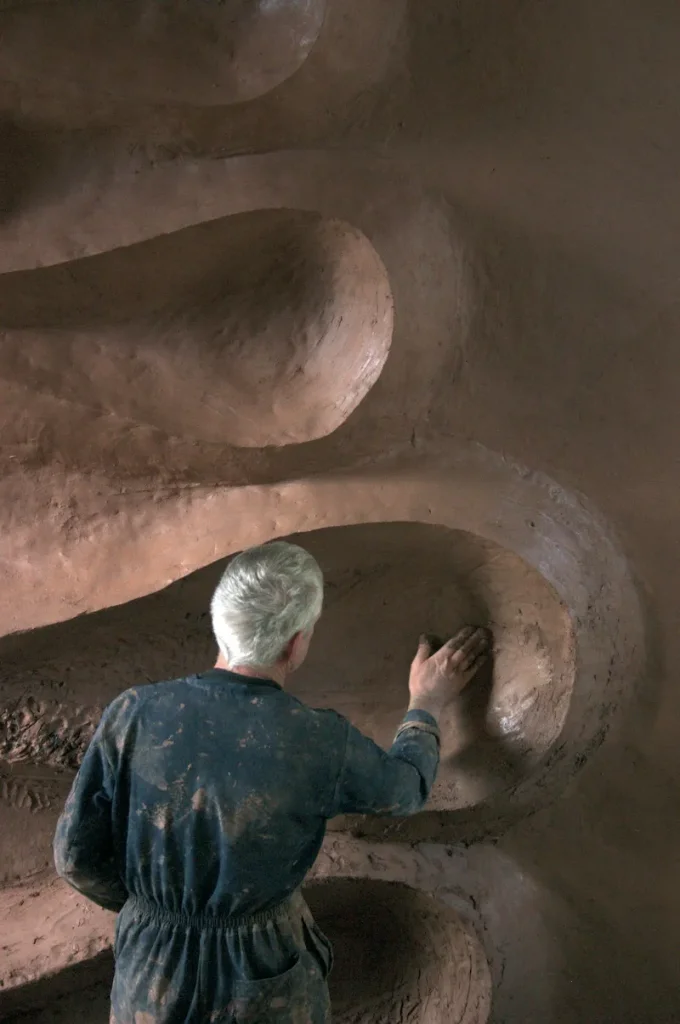
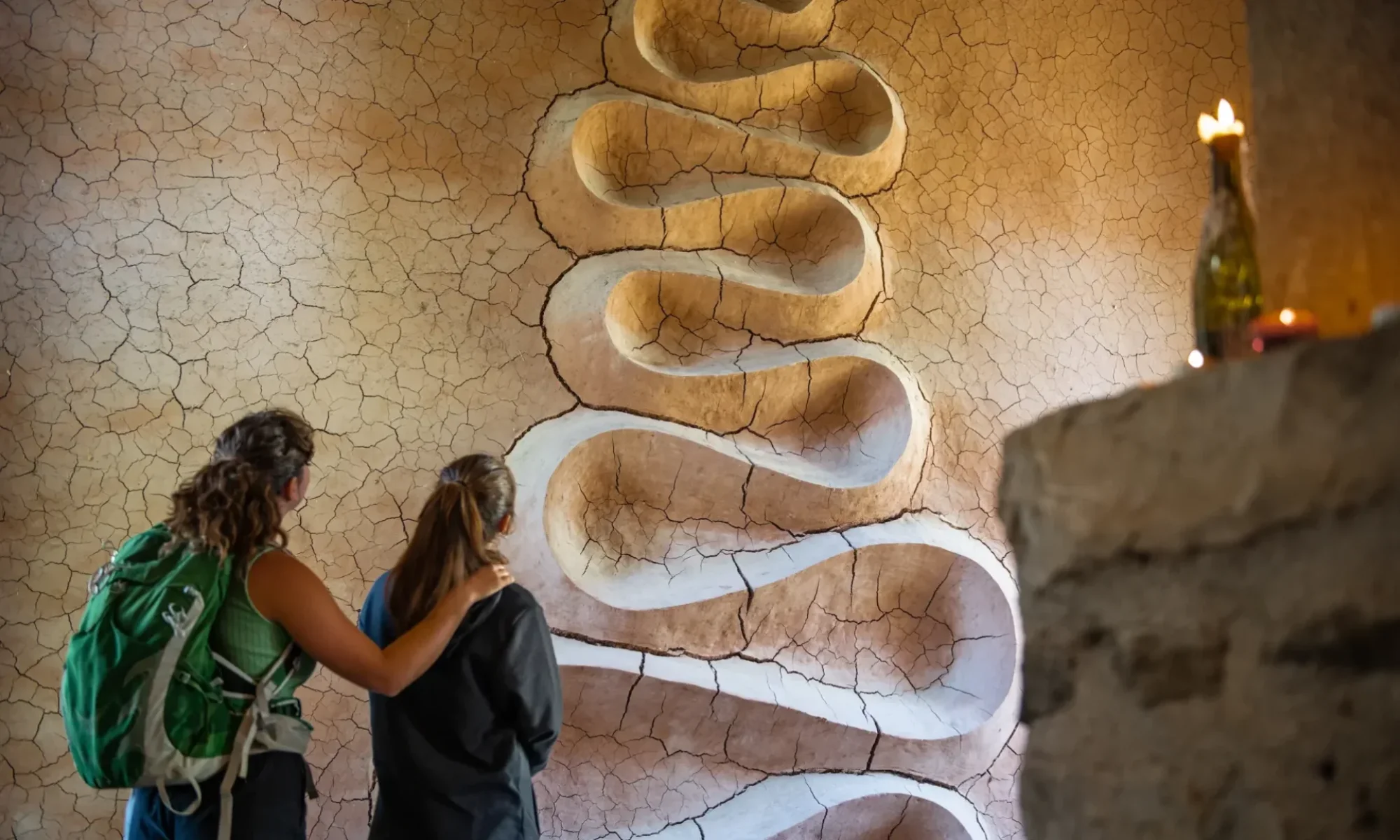
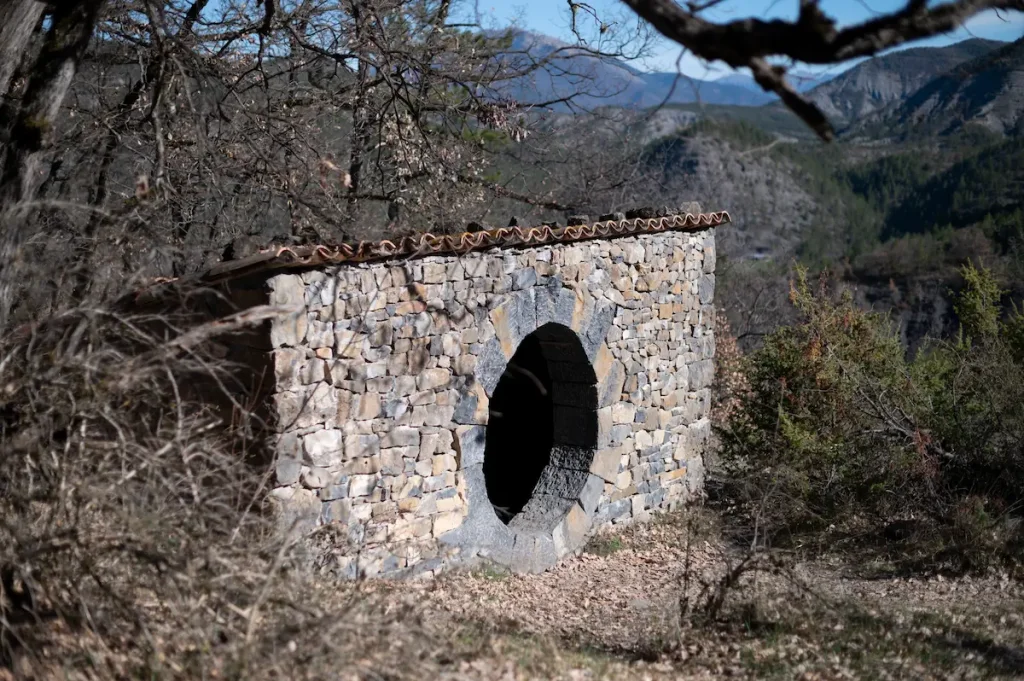
Refuge d’Art is a single piece, and the route through it belongs to the work. It links three monumental dry-stone cairns — the Sentinelles — and a series of ruined shepherds’ huts and roadside chapels that Goldsworthy rebuilt stone by stone, each one housing a single sculpture, each one with a door, a fireplace, a wooden bench, and a key. They are called refuges because that is what they are: you can sleep in them.
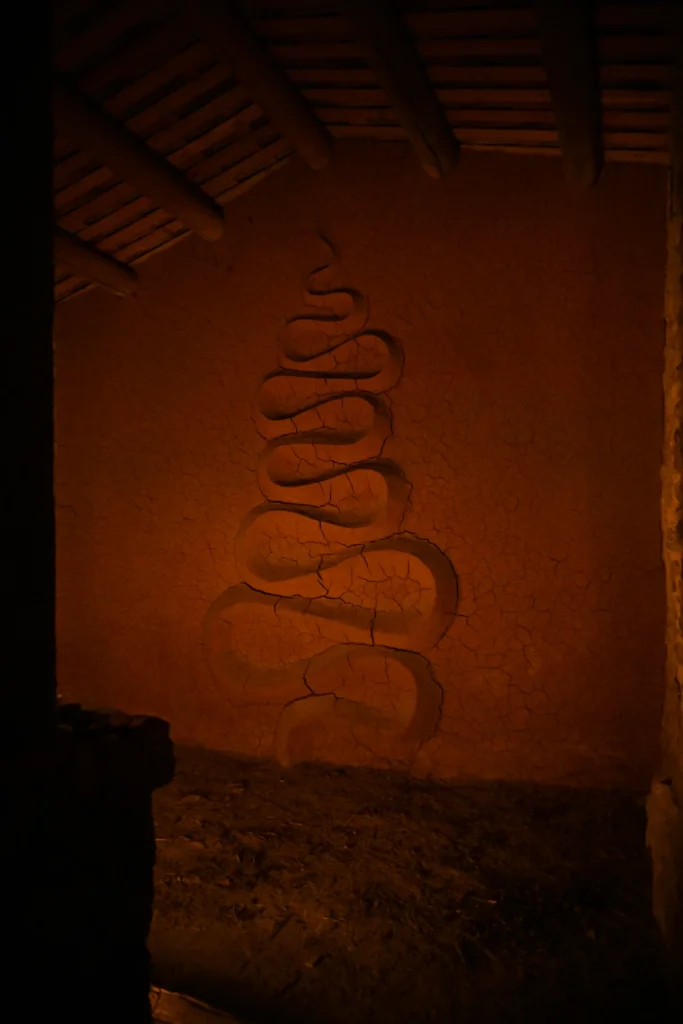
There is an enormous difference between seeing a piece of art for a few minutes in a museum and one that you actually live with for a little while and sleep with. Sleeping with a sculpture, it’s a beautiful idea. — Andy Goldsworthy, interview, 2002.
This is one of the largest concentrations of Goldsworthy’s work anywhere in the world, and the only place where he built work you are meant to sleep in. In 2026 he received the Praemium Imperiale for sculpture, awarded by the Japan Art Association and often described as the Nobel of the arts.
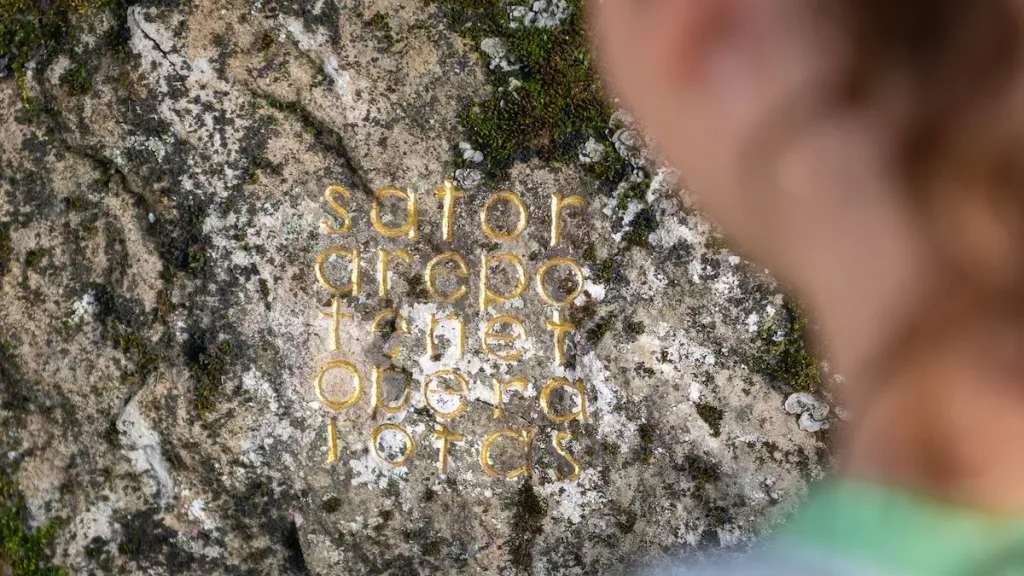
He is not alone out there. The Dutch artist herman de vries has left gold-leaf inscriptions on bare rock. The American Richard Nonas, an anthropologist before he was a sculptor, has marked the tension between human settlement and wild ground. Joan Fontcuberta, Reno Salvail, Till Roeskens and others have added work of their own.
Almost none of it is signposted. Much of it you would walk straight past.
Two ways to walk it
I have been guiding this route for eight years, in French. From 2027 I am running it in English, for small groups of English-speaking travellers.
Both tours cover the same collection and both end the same way, with a full day at Château La Coste.* The difference is how you sleep.
The 8-day Refuge d’Art hike
The 6-day hotel-based tour
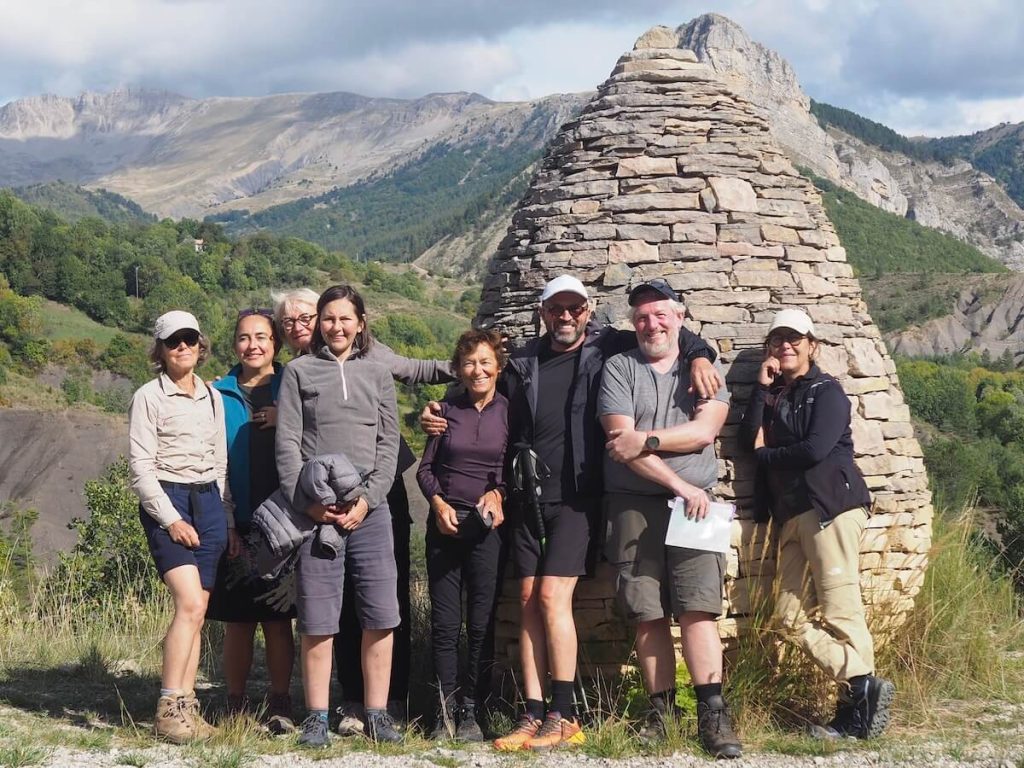
Most guests come alone or as a couple. They are typically between 45 and 70, regular walkers without being athletes — teachers, architects, doctors, curators, retired professionals. Almost none of them are art specialists, and none need to be.
* On scheduled departures, the last night is spent in Aix-en-Provence, with an evening walk through the old town before dinner.
Coming as a group of your own? Either tour can be taken privately, for two to eighteen people, on your own dates — and a private group can spend that last night at Château La Coste itself. Private departures →
The 8-day Andy Goldsworthy Refuge d’Art hike, day by day
The full immersion: five of Andy Goldsworthy’s Refuges d’Art, two Sentinelles, and two nights spent sleeping inside his sculptures.
Next departure: 24 to 31 May 2027. Places available.
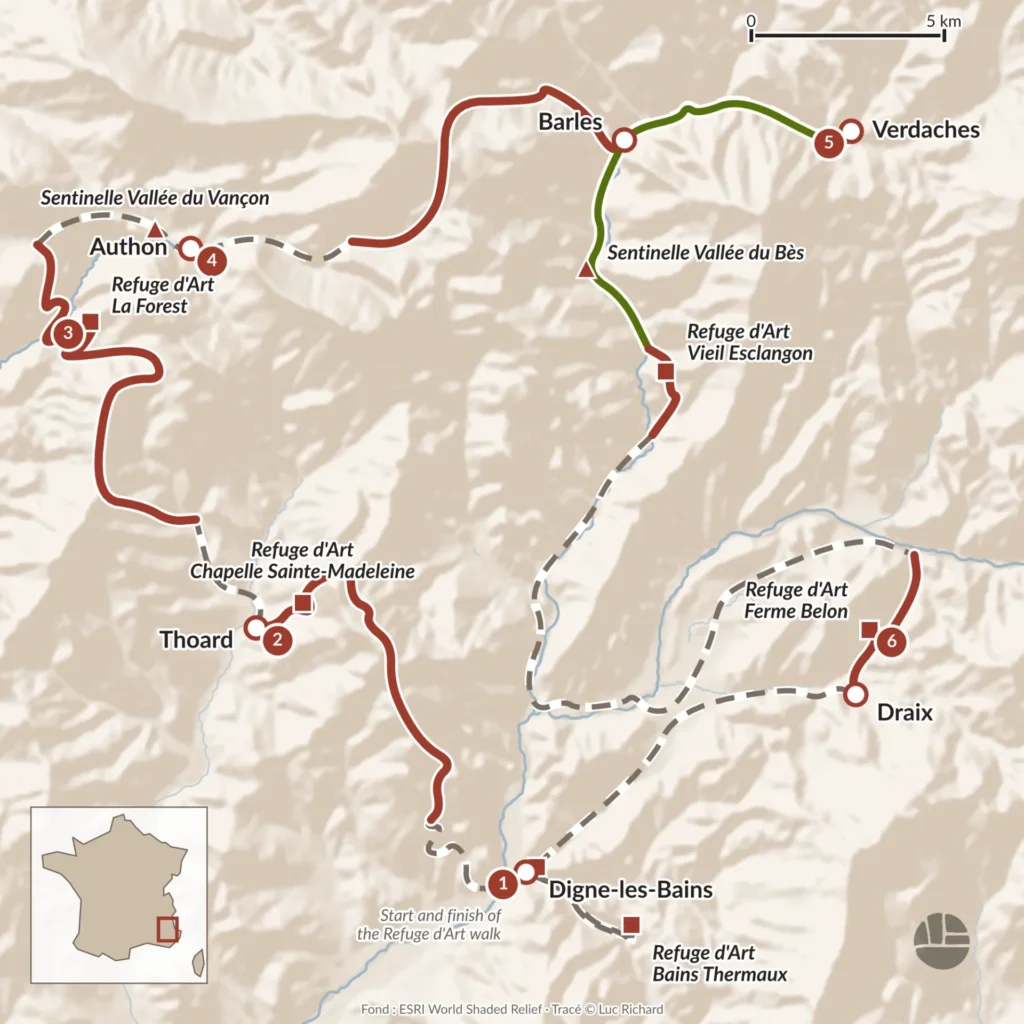
The complete Refuge d’Art trail runs for 150 kilometres and takes about ten days. This tour walks the best of it — some sixty kilometres over six days — with transfers across the linking stretches, so that the time goes on the works rather than on the road.
Day 1 — Aix-en-Provence to Digne-les-Bains
I meet you at 4:00 pm at Aix-en-Provence TGV station (or at Marseille Provence airport, if that suits your flights better). From there we drive north-east in a private vehicle — about an hour and three quarters, watching Cézanne’s Provence give way to the pre-Alps. Night at Le Refuge des Sources, a three-star hotel in Digne-les-Bains. Dinner together, a proper briefing. No walking.
Flying long-haul? Add the optional day in Aix-en-Provence and arrive the evening before, with a morning in the old town before we set off.
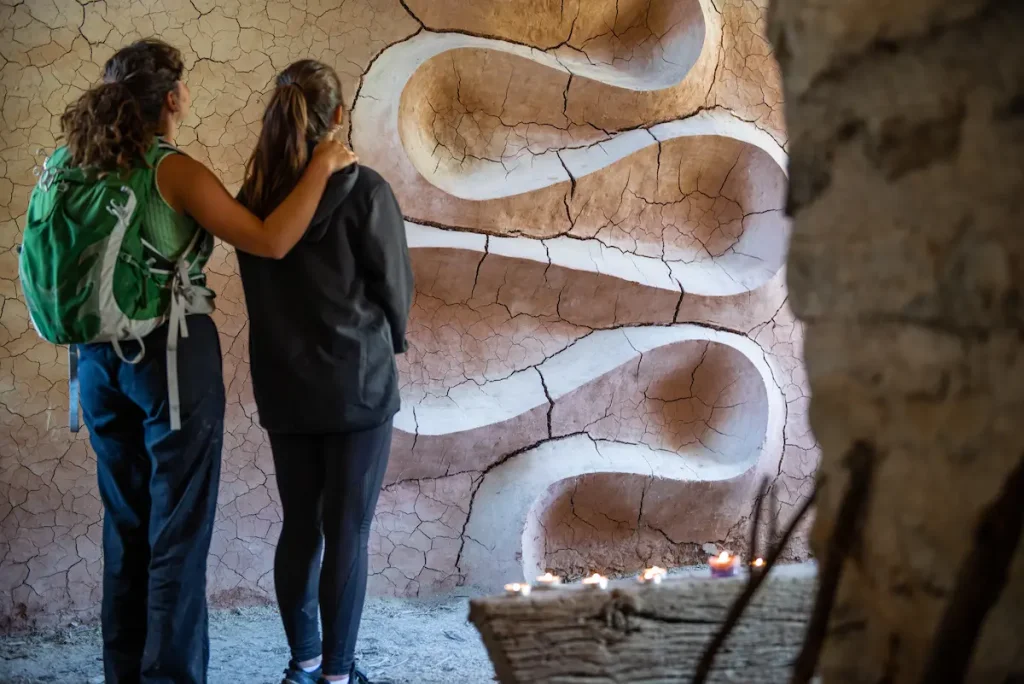
Day 2 — Courbons to Thoard: the first Andy Goldsworthy Refuge d’Art
A short transfer to the hamlet of Courbons, then out along the Siron ridges. A siesta after the picnic, as everyone does here. Late in the day, the Refuge d’Art Chapelle Sainte-Madeleine on its rocky promontory. Dinner under the plane trees at the Auberge de la Forge in the Provençal village of Thoard. Night at the village gîte. 13 km (8 miles) · +610 m / –650 m (+2,000 / –2,130 ft)
Day 3 — Over the col de Mounis to Refuge d’Art La Forest
A long ridge day, ending at the most remote of them all: Refuge d’Art La Forest, a rebuilt farmhouse with no electricity, no plumbing and no neighbours. Dinner cooked on site. Your first night sleeping inside a Goldsworthy. 13.5 km (8.4 miles) · +830 m / –730 m (+2,720 / –2,395 ft)
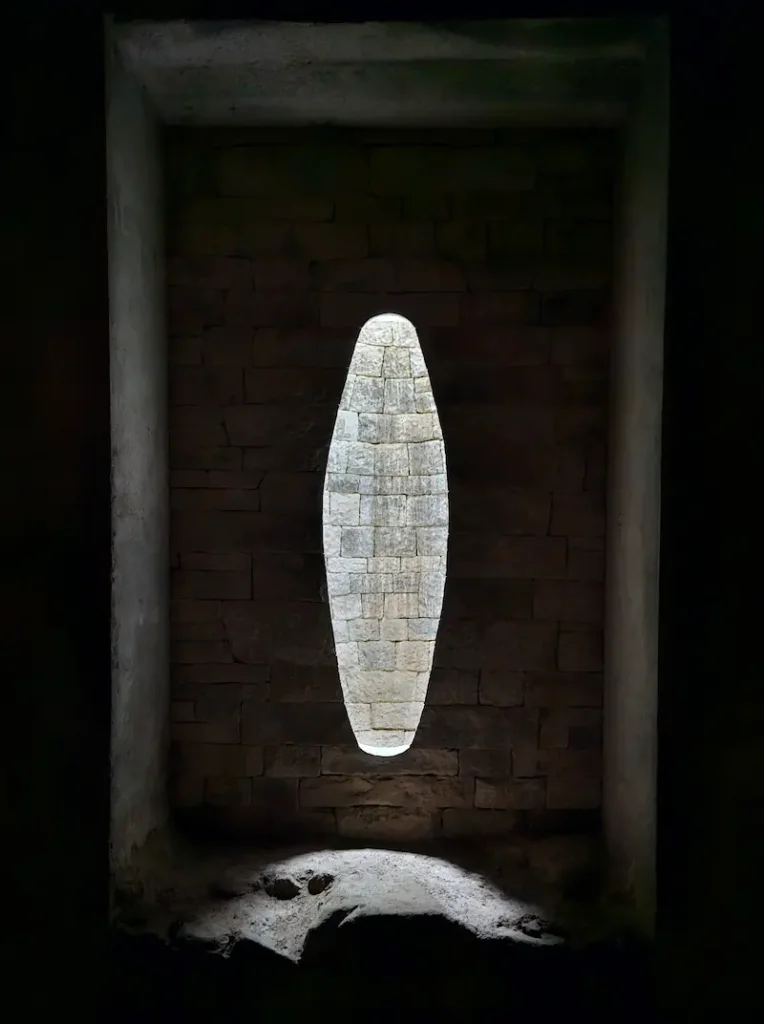
Day 4 — The Dromon chapel and Goldsworthy’s Sentinelle du Vançon
Down through the woods to the chapel of Dromon, whose crypt holds Roman-era remains, then to the first of the great Sentinelle cairns, standing alone in the Vançon valley. The afternoon is deliberately empty: rest, laundry, reading, deckchairs by the river at the Gîte des Monges in Authon. 9.7 km (6 miles) · +440 m / –300 m (+1,445 / –985 ft)
Day 5 — The high point: col de la Croix de Veyre
Transfer to Feissal. Up over the col de la Croix de Veyre at 1,886 m (6,188 ft) then down the Descoure ravine to find de vries’s fenêtres (windows). A stop at the village bistro in Barles. Night at the Flagustelle gîte in Verdaches, in the old village school. 12.6 km (7.8 miles) · +500 m / –910 m (+1,640 / –2,985 ft)
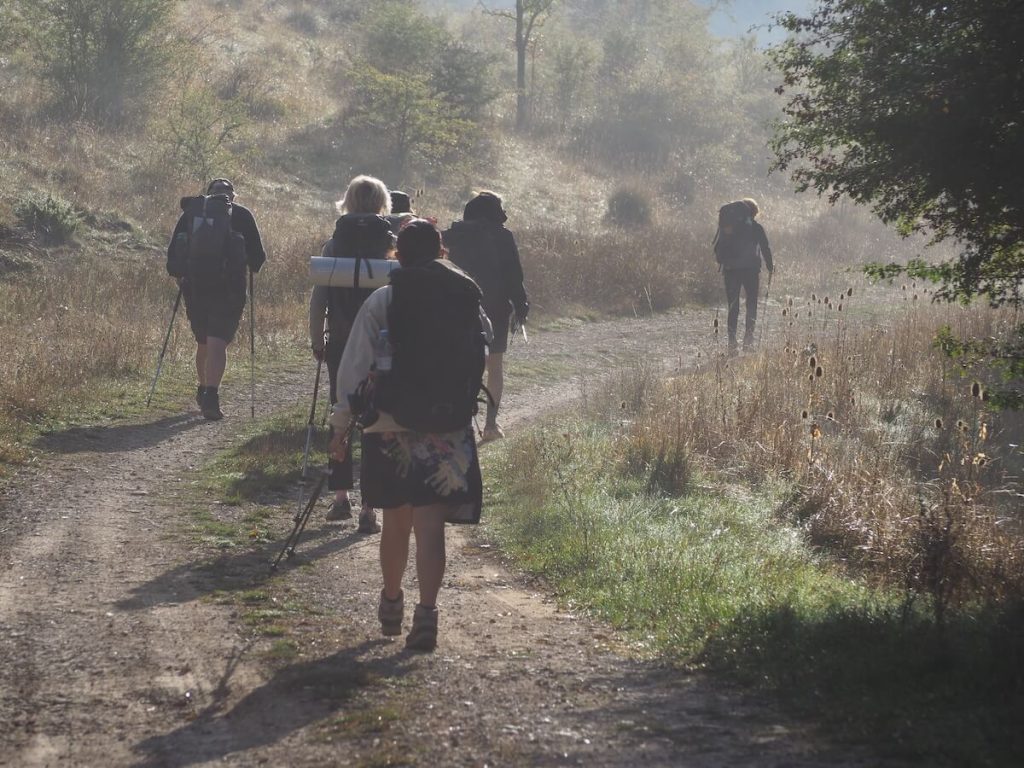
Day 6 — Bicycles, a fossil velodrome, and a second night inside a Goldsworthy
The one morning we don’t walk. Old Dutch bicycles, provided by the gîte, and a long easy freewheel on a quiet road at a 5% gradient — down through the clues de Barles, narrow gorges cut through the limestone, and past the Sentinelle du Bès, with works of other artists along the way. (A car is available for anyone who would rather not cycle.)
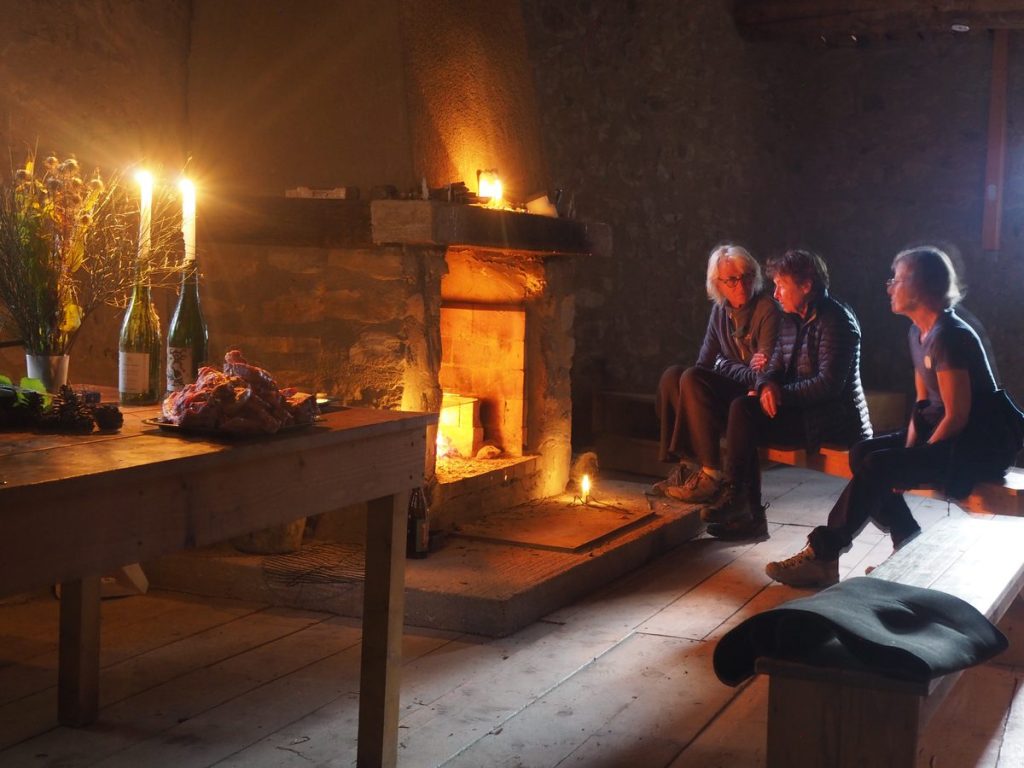
Then on foot, up the bed of a fossilised river, to Refuge d’Art Vieil Esclangon in the ruins of the abandoned village. A short climb to the viewpoint over the Vélodrome — a twenty-million-year-old river delta turned to stone and tilted on its side, one of the most remarkable geological sites in Europe. Transfer and a short walk to Refuge d’Art Ferme Belon, with its great fireplace. Dinner by candlelight, lamb grilled over the embers. 11 km (6.8 miles) · +475 m / –385 m (+1,560 / –1,265 ft)
Day 7 — Goldsworthy’s River of Earth, then Château La Coste
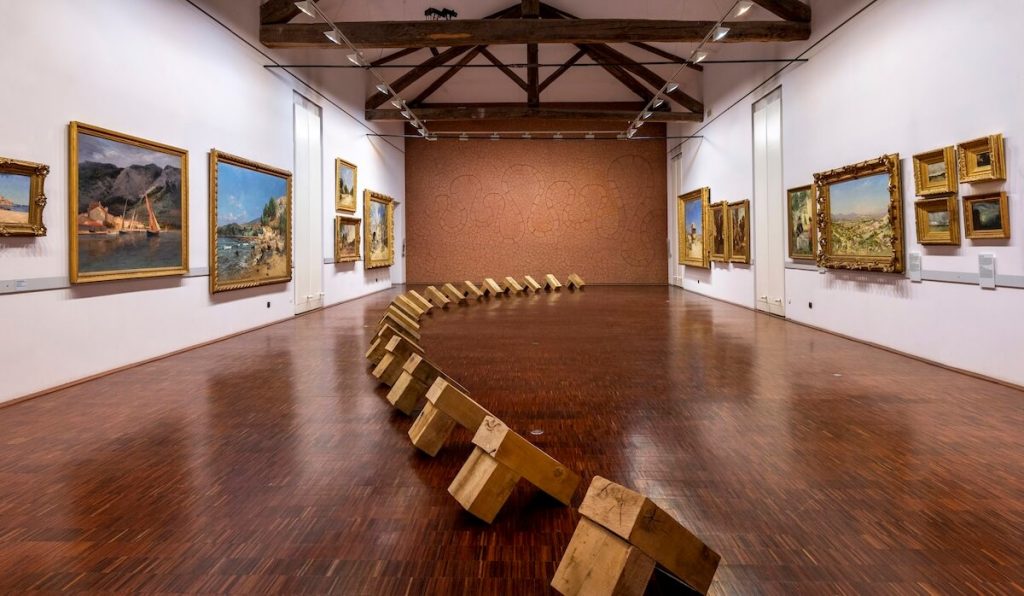
A last short walk from Ferme Belon down to Draix, a transfer and a brief climb to Refuge d’Art Bains Thermaux for the picnic. Back into Digne for the Musée Gassendi and Goldsworthy’s River of Earth — the work that gathers the whole week into a single room and, in my experience, the moment the trip finally makes sense to people.*
Late afternoon, we drive south to Aix-en-Provence (about an hour and three quarters). An evening walk through the old town — the plane trees of the Cours Mirabeau, the fountains, the Mazarin quarter — then dinner, and the night in a hotel in the centre.* 3.7 km (2.3 miles) · +70 m / –210 m (+230 / –690 ft)
* During the Musée Gassendi’s building works, the museum visit is replaced by a visit to the Maison Alexandra David-Neel.
Day 8 — Château La Coste
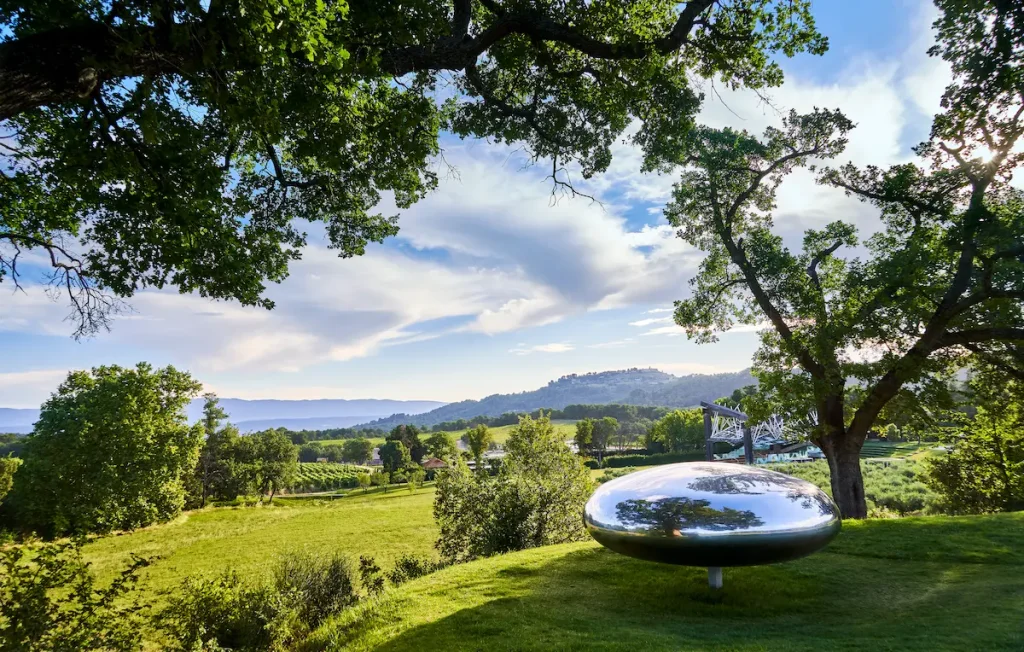
Twenty minutes’ drive out to Château La Coste, then the guided Art & Architecture Walk in English through the morning. Lunch at the Tadao Ando Café Restaurant. Cellars and tasting in the afternoon. I drop you at Aix-en-Provence TGV station (or Marseille airport) at 5:00 pm.
The 6-day hotel-based Andy Goldsworthy tour, day by day
Four of Andy Goldsworthy’s Refuges d’Art, a Sentinelle, and a hot bath every evening.
Next departure: 3 to 8 June 2027. Places available.
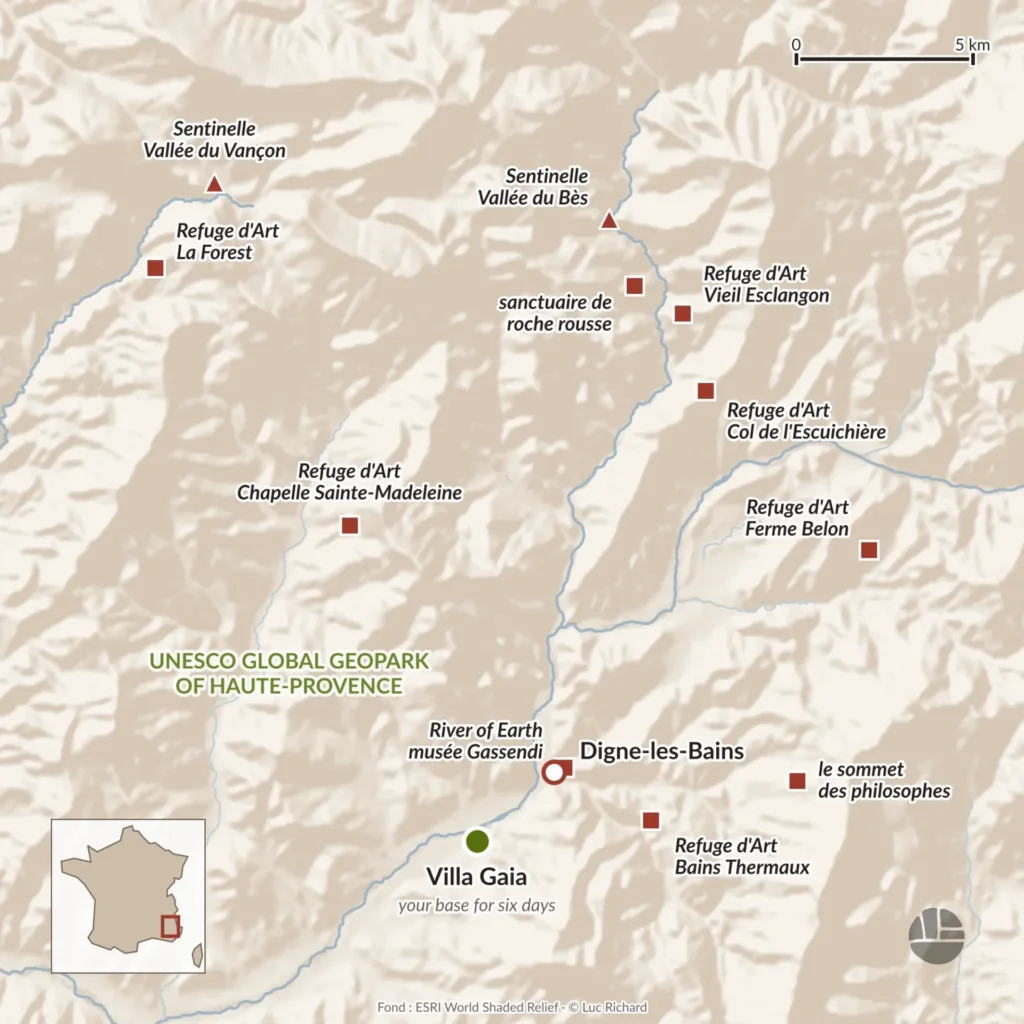
Some people want to see this work but would rather not carry a pack over a 1,886-metre col, and there is nothing second-best about that. You will still stand inside four of Goldsworthy’s rebuilt refuges — Chapelle Sainte-Madeleine, La Forest, Vieil Esclangon and Ferme Belon — and finish in front of River of Earth at the Musée Gassendi.
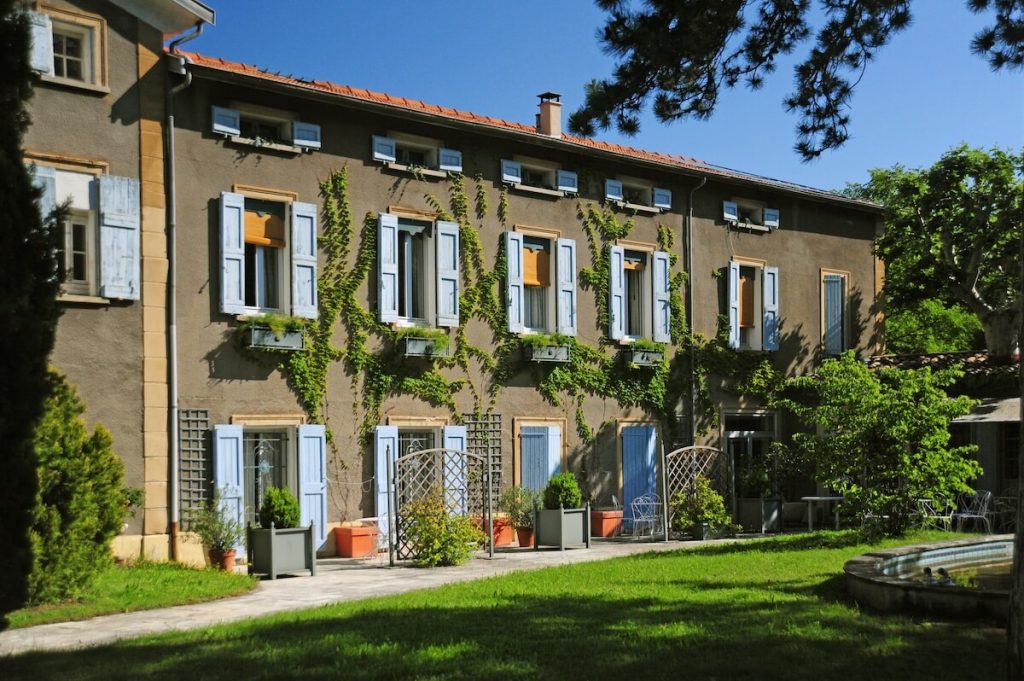
Day 1 — Aix-en-Provence to the Villa Gaia
4:00 pm at Aix-en-Provence TGV station (or Marseille Provence airport), then the drive north to the Villa Gaia, a three-star country house built in 1730 and restored in the nineteenth century by a family of Alpine merchants back from Mexico. Original furniture, generous rooms, a wooded garden, no televisions. Anne-Françoise cooks from the kitchen garden and the local farms; dinner is at eight, at one table.
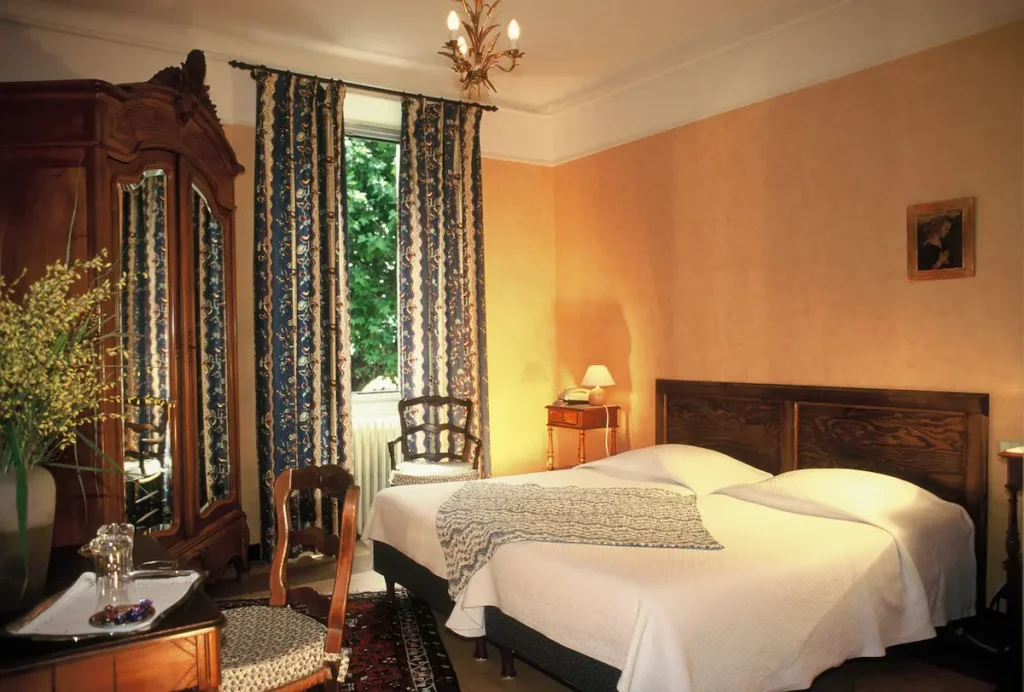
Day 2 — Two Andy Goldsworthy Refuges d’Art in a day
Two walks, and two of the rebuilt refuges. In the morning, an out-and-back from the village of Thoard to the Refuge d’Art Chapelle Sainte-Madeleine, perched on its promontory. Picnic. In the afternoon we drive round into the Vançon valley for the walk in to Refuge d’Art La Forest, the most isolated building Goldsworthy rebuilt, and one that hotel-based visitors do not normally get to see. Night at the Villa Gaia. 4 km (2.5 miles), +300 m (1,000 ft) in the morning; forty-five minutes each way, +200 m (650 ft) in the afternoon.
Day 3 — Roche Rousse and the sanctuary of nature
A day given to herman de vries rather than to Goldsworthy. We climb the right bank of the river Bès through black pine and oak to a rocky ridge above the valley, then into the bois sacré, the wood he considered inhabited by spirits, where he built his sanctuaire de la nature. A tiny Orthodox hermitage makes the picnic spot. Coming down, we pass beneath the vertiginous blade of Facibelle, and on the drive back we stop at the “ammonite slab”, a two-hundred-million-year-old sea floor standing on end. 5 km (3.1 miles) · +420 m / –380 m (+1,380 / –1,245 ft) · about 4 hours
Day 4 — Refuge d’Art Vieil Esclangon, the Vélodrome and Alexandra David-Neel
The left bank this time, and the walking turns into a time machine: you cross the reddish bed of a tropical lagoon where palms, dwarf rhinoceroses and large wading birds lived twenty million years ago. Refuge d’Art Vieil Esclangon answers the climb, and a short scramble opens the view over the Vélodrome. In the ruins of the old village, herman de vries’s gold-leaf traces; in the Bès valley below, a Sentinelle.
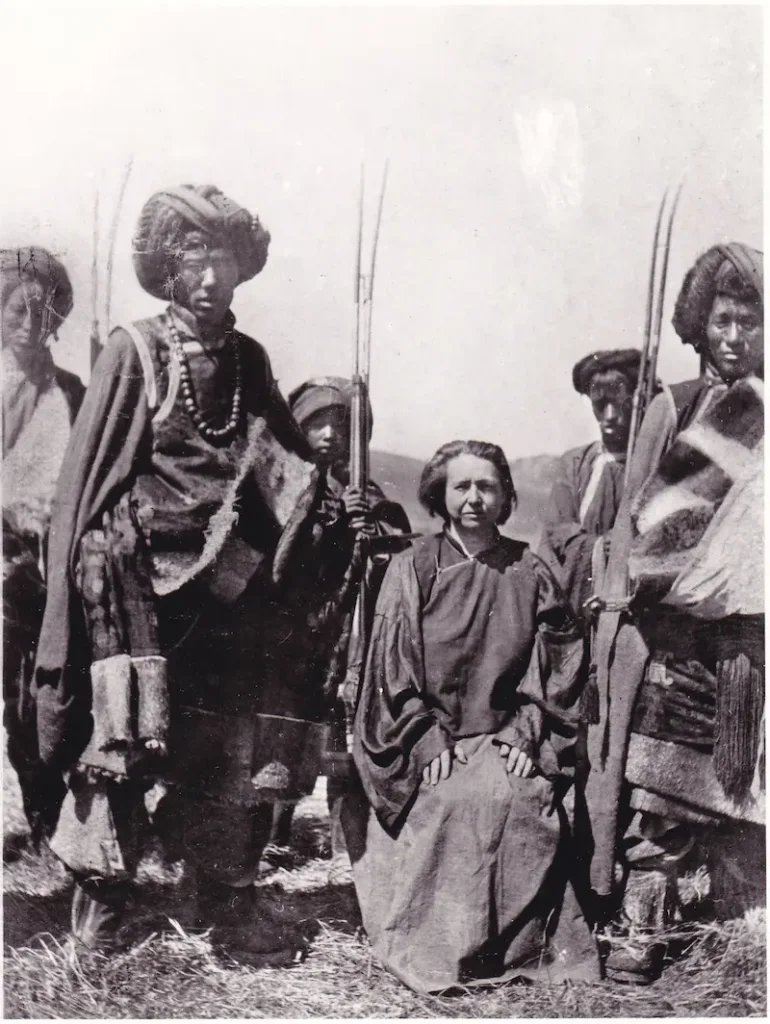
Back in Digne, the recently restored house of Alexandra David-Neel — opera singer, anarchist, orientalist, and in 1924 the first European woman to reach Lhasa — with its adjoining museum of Asian art. 5.6 km (3.5 miles) · +280 m / –330 m (+920 / –1,080 ft)
Day 5 — Refuge d’Art Ferme Belon, Goldsworthy’s River of Earth, then Château La Coste
We check out and drive to Draix for the last Goldsworthy of the trip: Refuge d’Art Ferme Belon, reached along the rim of canyons carved into black marl, a landscape that looks less like Provence than like the moon. Picnic at the refuge. In the afternoon, the Musée Gassendi* and River of Earth, the work that gathers the whole week into a single room. Then south to Aix-en-Provence, an evening walk through the old town, dinner, and the night in the centre of the city. 4 km (2.5 miles) · +150 m / –150 m (+490 / –490 ft)
* During the Musée Gassendi’s building works, the museum visit is replaced by a visit to the Cairn art centre.
Day 6 — Château La Coste
As for the hike: the short drive out to Château La Coste, the guided Art & Architecture Walk in English, lunch at the Tadao Ando Café Restaurant, cellars and tasting, and Aix-en-Provence TGV station at 5:00 pm.
Château La Coste: the counterpoint
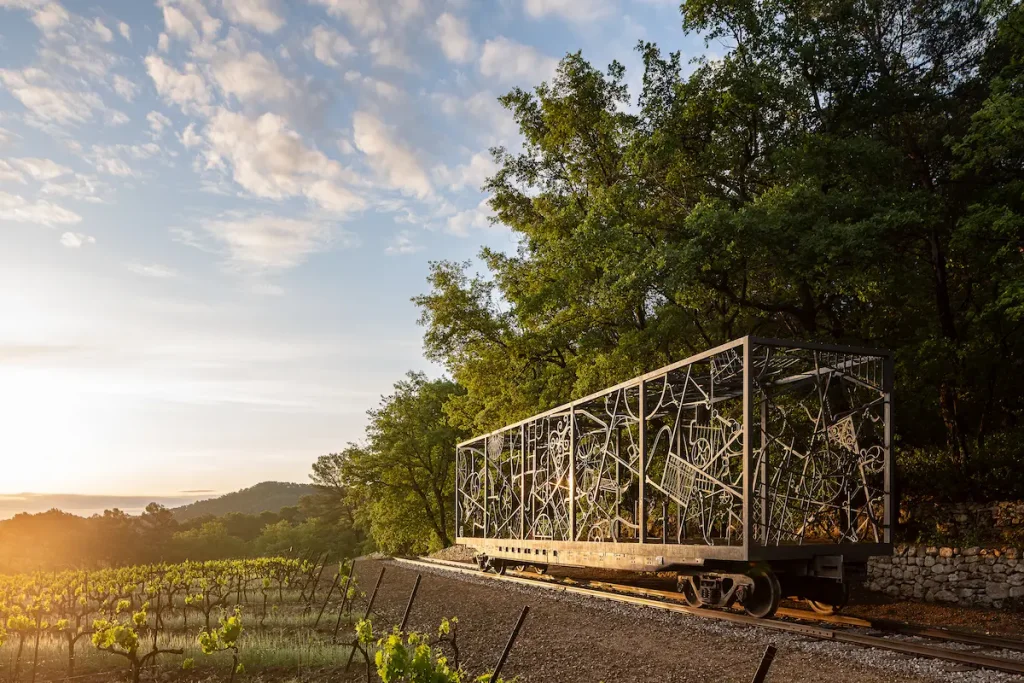
The last day is a shock, and that is why it is there.
You arrive off a week in which nothing was signposted. Above Digne, the works are unlit and unlabelled; several of them you would walk straight past, and I have watched people do exactly that before I said anything. No guards, no opening hours, nobody else on the path. Goldsworthy rebuilt those refuges out of the stones lying around them, and reaching one takes five hours on foot.
Then, an hour and three quarters south, someone hands you a glass of rosé on a terrace in the middle of two hundred hectares of vines.
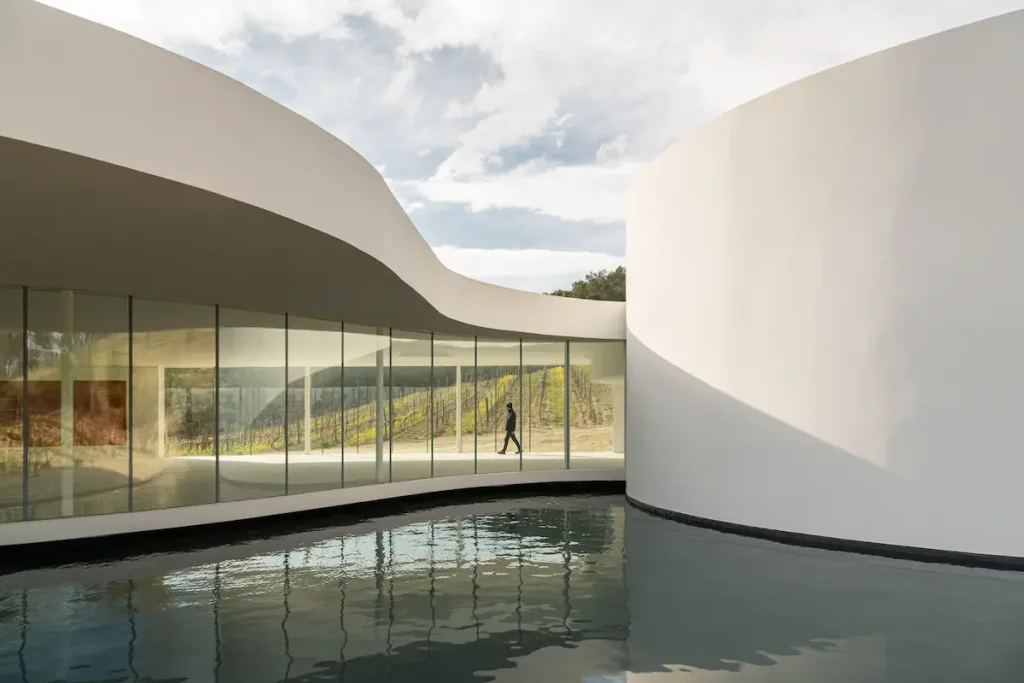
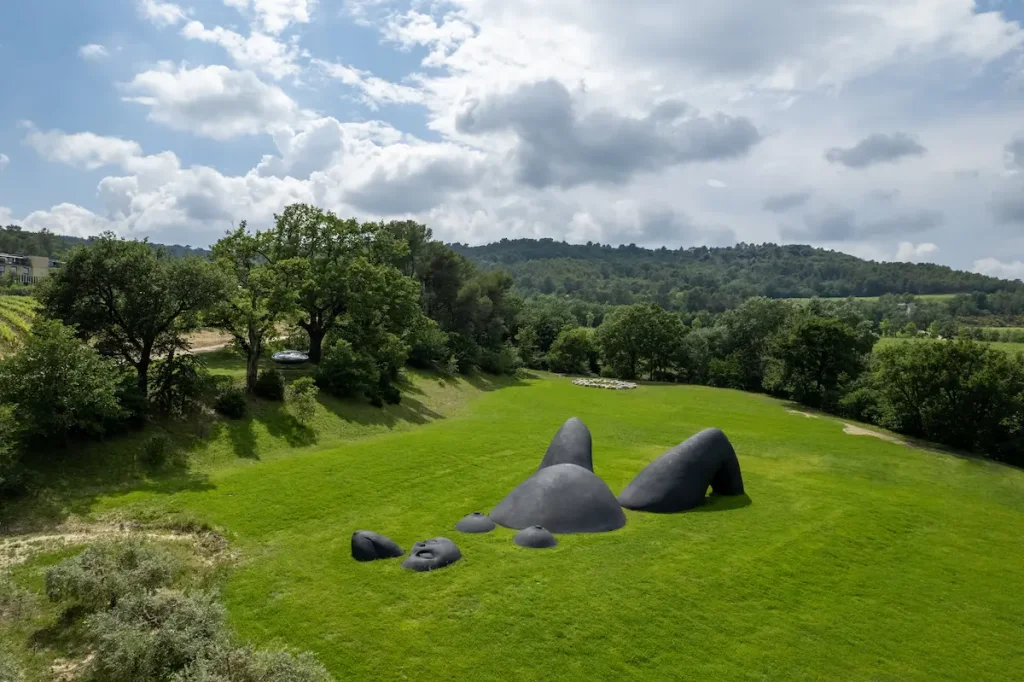
Château La Coste holds more than forty works on a four-kilometre circuit through vineyard, olive grove and stone pine: Louise Bourgeois, Richard Serra, Ai Weiwei, Bob Dylan and a dozen others, among buildings by Tadao Ando, Jean Nouvel, Frank Gehry and Renzo Piano. Each artist chose their own site and made the work for it. Everything here is confident, generous, and built to be looked at. Ando’s concrete art centre stands in a shallow lake with Bourgeois’s Crouching Spider reflected beside it; I think it is one of the finest things put up in Provence in the last fifty years, and I never tire of watching people come round the corner and stop in their tracks.
Two collections, both of them art placed outdoors to live in a landscape, at opposite ends of what that can mean. The week above Digne leaves a physical imprint — in the legs, in the shoulders, in the memory of cold stone under a sleeping mat at four in the morning — and that imprint is what holds the works. Months later it is the body that gives them back to you. My guests usually begin to understand Digne on the drive south to La Coste, and they go on understanding it long after they are home.
Oak Room: where the two collections meet
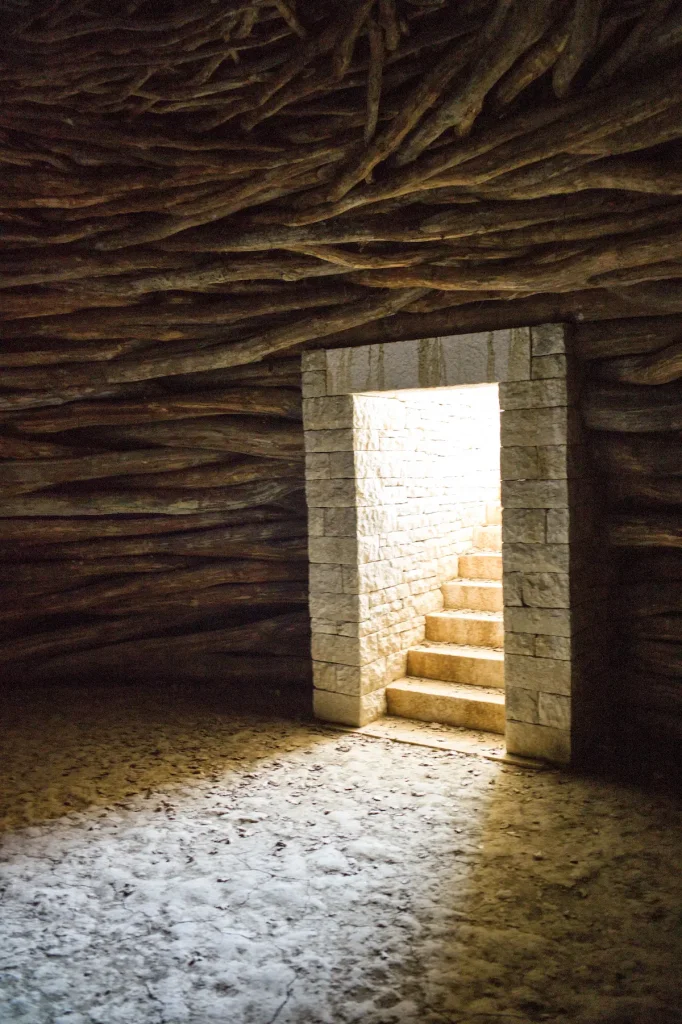
Halfway round the circuit there is a low doorway in a dry-stone wall, and it is Goldsworthy again.
Oak Room (2009) is a chamber built into that wall from around twelve hundred pieces of Burgundy oak, interlocked so tightly the structure carries itself. You stoop to get in. Inside it is dark and it smells of wood. It is one of the most impressive Goldsworthy works I know — and anyone who has spent the week sleeping in his shepherds’ huts recognises it on sight: the same low door, the same insistence that you go in instead of looking, the same use of what was already on the ground.
In the afternoon we go underground into Jean Nouvel’s winery — ten metres high, seventeen metres below ground — for a tour of the cellars and a tasting.
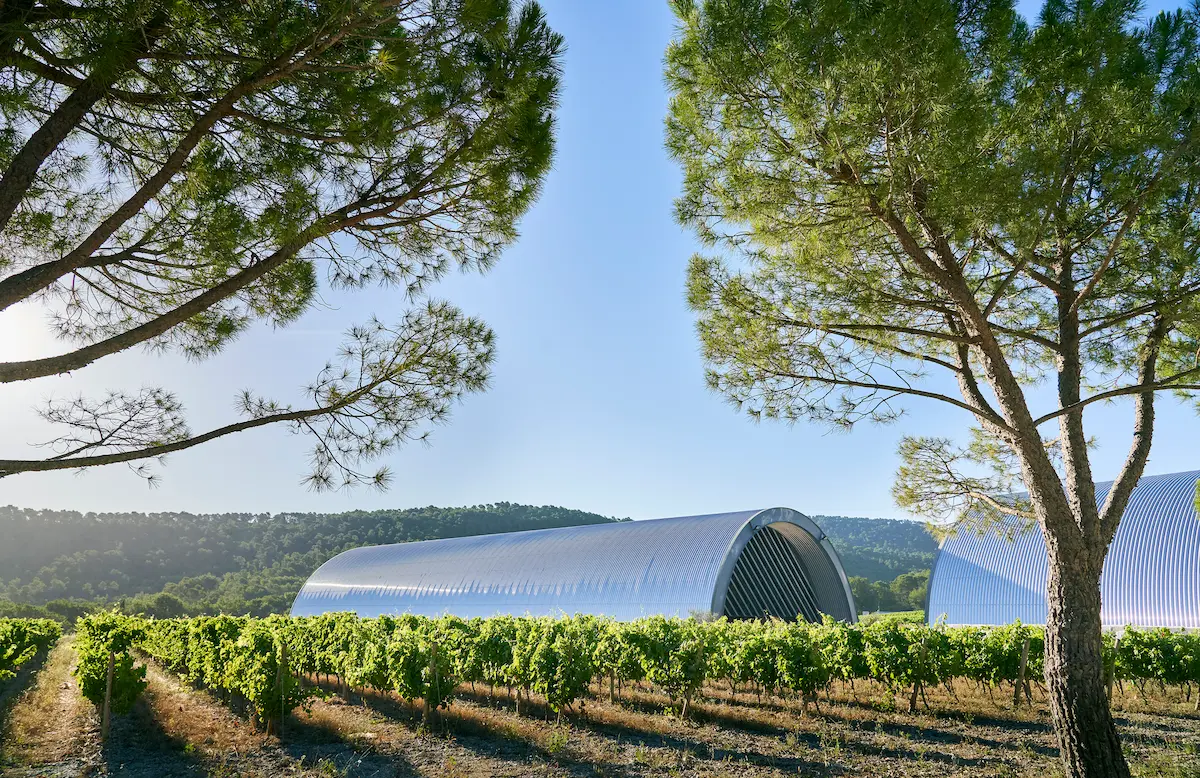
Wine has been made on this land since Roman times; the Palladian country house dates from 1682, and the estate has been certified organic since 2009 and biodynamic since 2013. After a week of food cooked over a fire in buildings with no electricity, it is a very agreeable way to come back to the world.
Your guide: Luc Richard
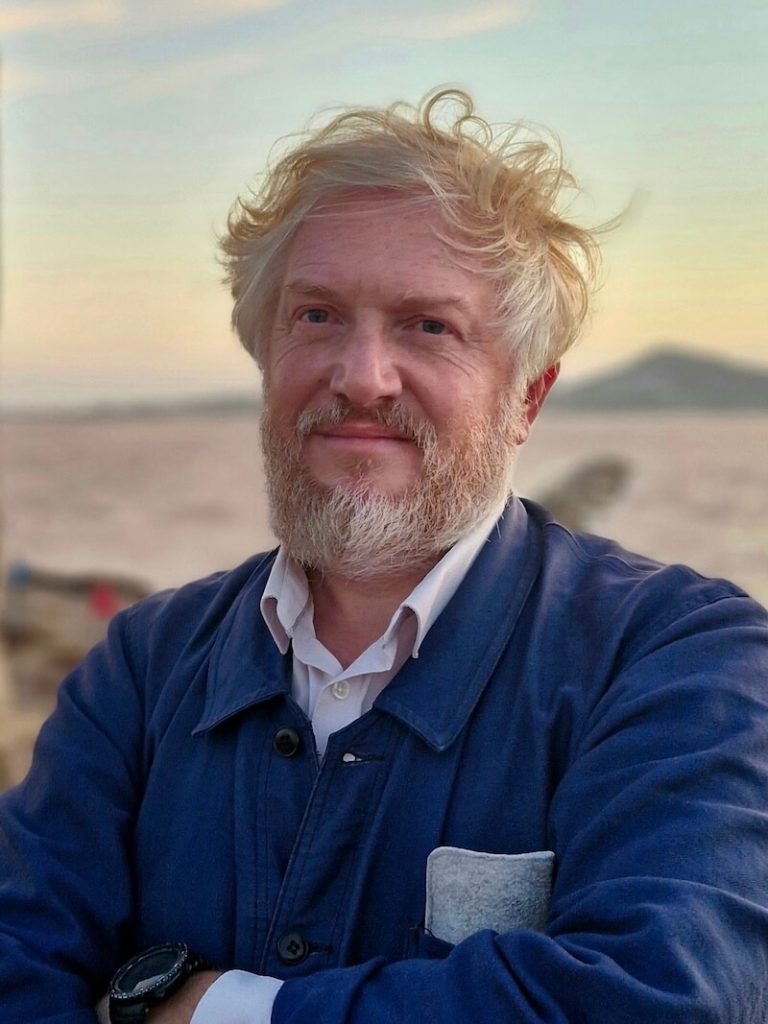
[The guides] will be guardians and interpreters of the sculpture, the walk. Because the sculptures are not just the stone, it’s the whole house, and the whole walk. The whole thing is a piece of art. The guides will be critical to making it function as a complete form. — Andy Goldsworthy, on the guides of the Refuge d’Art, interview, 11 April 2002
State-certified mountain leader (Accompagnateur en Montagne). The French national qualification for professional guiding in mountain terrain, held after formal training and examination.
Mountain art guide certified by the Musée Gassendi. One of a small number of guides formally accredited by the museum to interpret the Collection d’Art en Montagne.
Eight years guiding this particular route — and, by common consent of previous guests, the cook.
Writer and former journalist. Correspondent in China for Géo, L’Express, Grands Reportages and Marianne. Ten years living in Beijing, Mandarin studied at the Beijing Language and Culture University, and several published books, including Voyage à travers la Chine interdite (Pocket, 2016). Graduate of Sciences Po Lyon.
A long-distance walker. Two months in the uninhabited part of Tierra del Fuego; a 500-kilometre unsupported traverse of Iceland, 80 km of it across glacier; nearly thirty years of walking in Tibet and western China.
Trained in wilderness first aid, and carrying emergency communications equipment. All participants are automatically covered by my professional insurance, which includes search and rescue costs, including helicopter evacuation from the scene of an incident. I strongly recommend comprehensive travel, medical and cancellation insurance as well, for anyone travelling from abroad.
I designed both of these tours myself and I lead them myself. The group sets the pace. Nobody is left at the back on their own. And the person talking to you about herman de vries at eleven in the morning is the person cooking your dinner at eight.
Direct line: +33 6 08 16 66 44 (WhatsApp / Signal) · luc@lucrichard.fr
In July 2026, The Connexion reported on the launch of these English-language tours in an article by Jessica Jones.
What previous guests say
Five-star Google reviews left by guests on the French-language editions of these tours, translated from the French.
“Mountains as spectacle, art along the way, epicurean food on the plate, shared joy. This week was exceptional. Thank you, Luc, for adjusting the pace, for sharing your passion for herman de vries, for looking after us the whole way. We lived a suspended experience.”
— Lorraine, October 2025, Refuge d’Art hike
“I don’t normally hike, and I struggled on some of the climbs. Luc was very patient and understanding, and went as far as shortening some routes to make them easier. I warmly recommend this experience of seeing superb works of art in the middle of breathtaking landscapes.”
— Elena, June 2025, Refuge d’Art hike
“A guide-lecturer of great erudition, as compelling on geology, botany and philosophy as on contemporary art. Kindness, thoughtfulness and good humour throughout.”
— Chloé, June 2025, Chemins d’Art tour
Everything is taken care of from the moment you arrive
From 4:00 pm on Day 1 at Aix-en-Provence TGV station until 5:00 pm on the last day at the same station, you do not have to organise a single thing. No hire car, no rural bus timetables, no taxi negotiated in French at a station where nobody speaks English, no wondering where lunch is coming from. I meet you on arrival. There is a dedicated vehicle for the whole trip. Every transfer, every night, every meal and every entrance ticket is arranged and paid for in advance.
The tours are operated by Vercors Escapade, a licensed French travel agency, which means your booking carries the financial protection French law requires of a tour operator. I design and lead the tours; the agency handles the contract, the payment and the bonding.
The food
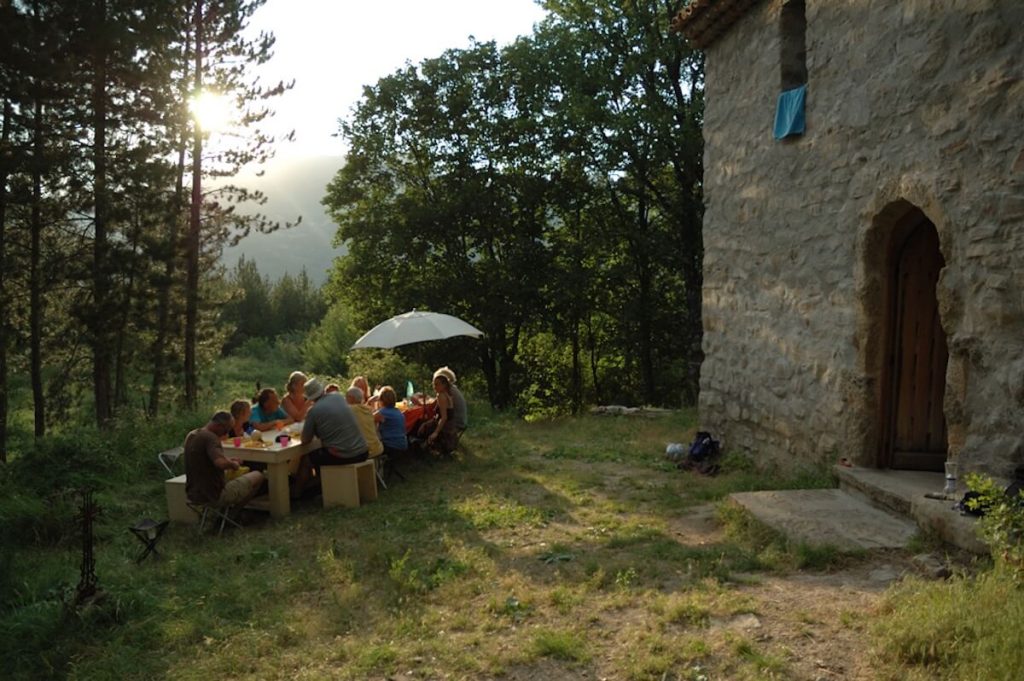
Dinners on the hike are cooked on site, on a wood fire or in the fireplace: fresh goat’s cheese, vegetables, pulses and spices, country bread, lamb chops over the embers. Ingredients are organic and local, bought in bulk in glass and paper — part of a deliberate low-waste, low-carbon approach that also explains why we carry our own luggage rather than have it driven between refuges by 4×4. Picnics are made fresh each morning. At the Villa Gaia, Anne-Françoise cooks from the kitchen garden and the season.
Tell me about allergies and dietary requirements when you book and I will build the menus around them.
Prices and what they include
Refuge d’Art hike — 8 days / 7 nights
- €1,690 per person (approx. US$1,965)
- Group of 5 to 8
- Optional sleeping kit rental: €70 (approx. US$74) — Valandré Mirage down sleeping bag (French-made, 750 g, comfort rating 0°C / 32°F), inflatable mat, silk liner, inflatable pillow. Handed to you on the evening of Day 1, so you never carry it on a day of walking. Ideal if you are flying in.
- Single room for Night 1 (Digne) and Night 7 (Aix-en-Provence): on request
Chemins d’Art tour — 6 days / 5 nights
- €1,590 per person (approx. US$1,850)
- Group of 6 to 10
- Single room for the whole stay (Villa Gaia and Aix-en-Provence): on request
Included in both
- All accommodation, from the night of Day 1 to the night before departure
- All meals from dinner on Day 1 to lunch on the final day — dinners, breakfasts and picnics
- All transport from Aix-en-Provence TGV station onwards: station or airport pick-up, every transfer during the trip, and the drop-off at the end
- Guiding throughout, in English, by a state-certified mountain leader and Musée Gassendi certified mountain art guide
- All entrances and visits: Musée Gassendi, Dromon chapel, Maison Alexandra David-Neel (hotel-based tour), the guided Art & Architecture Walk at Château La Coste, and the cellar tour and tasting
- Bicycle and helmet loan on Day 6 (hike)
- Cutlery kit, watertight picnic box and metal plate, given to you on the first morning (hike)
- Professional guide insurance including search and rescue
Not included
- Travel to Aix-en-Provence TGV station or Marseille airport, and travel after the end of the tour
- Any transport during the tour for personal convenience
- Drinks, alcoholic and soft, other than those included at certain accommodations and at the Château La Coste tasting
- Travel, medical and cancellation insurance
- Personal expenses
- Nights before or after the tour
Dates
The 8-day Refuge d’Art hike — 24 to 31 May 2027.
The 6-day hotel-based tour — 3 to 8 June 2027.
Places are open on both 2027 departures. Bookings open at the end of September, and the waiting list is written to first. An October departure will follow; the dates are being finalised with the accommodations and will go to the waiting list first. Groups are small, and these are the good months here, with warm days, cool nights and dry weather.
Private departures
Either tour can be taken privately, for two to eighteen people — a family, a group of friends, a museum or gallery party, an association taking a whole departure. The dates, the pace and the balance of walking and looking are set with you.
There is one limit, and it is not a commercial one. The Refuges d’Art hold very few people, and that is part of what makes a night inside one what it is. Private departures on the 8-day hike are therefore capped at eight. Beyond that number, the 6-day hotel-based tour takes the whole group, up to eighteen — and above twelve, a second guide certified by the Musée Gassendi joins us for the entire trip.
Private groups also choose their last night:
- Aix-en-Provence — a hotel in the centre, and the evening among the fountains and plane trees of the Cours Mirabeau.
- Château La Coste — dinner and a night on the estate itself, driving down from Digne-les-Bains at the end of the afternoon. This is the one thing a private group can have that a scheduled departure cannot.
Private departures are quoted individually. Tell me a little about who you are, how many people will be joining you, and roughly when you would like to travel, and I will come back to you with a proposal.
Getting here
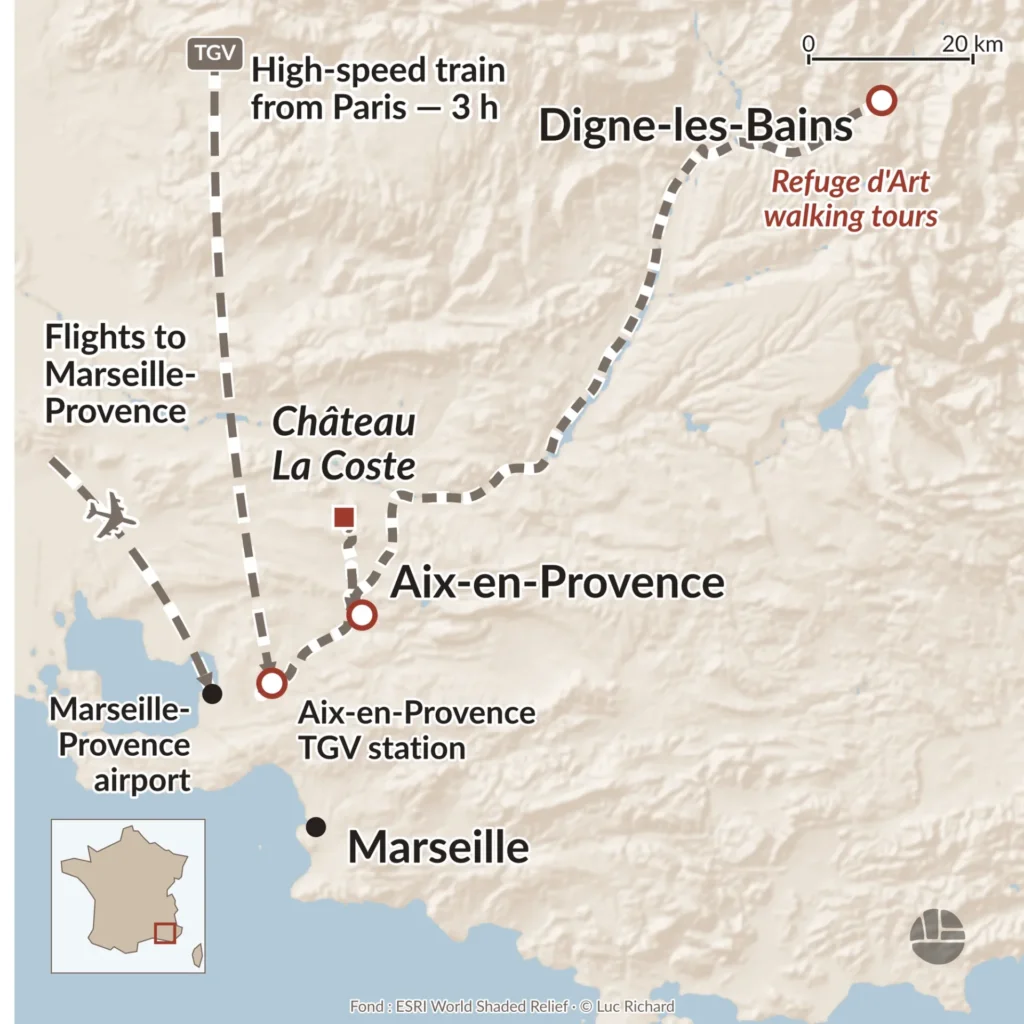
By air. Marseille Provence airport (MRS) has direct flights from London, Dublin, Amsterdam, Frankfurt, Munich, Geneva and most European hubs, with one-stop connections from North America and Australia via Paris, Amsterdam, Frankfurt or Istanbul. The airport is about twenty minutes from Aix-en-Provence TGV station, and I can meet you at either. See the map at the top of this page for how it all fits together.
By rail. Aix-en-Provence TGV is three hours from Paris. There are direct TGV services from Paris Charles de Gaulle airport, so you can land at CDG, walk to the platform inside the terminal, and be in Provence the same afternoon. From London, Eurostar reaches Paris Gare du Nord, with a change of station to Gare de Lyon for the TGV south.
Arriving a day early is a good idea if you are flying long-haul. The simplest way is to add the optional day in Aix-en-Provence; if you would rather organise the night yourself, tell me and I will suggest hotels.
Frequently asked questions
Do I need to speak French?
No. These tours are run entirely in English, for English-speaking groups. All commentary and briefings are in English, the guided tour at Château La Coste is in English, and I handle every interaction with drivers, hotels, refuge keepers and museums on your behalf. Bring the three words of French you enjoy using; you will not need a fourth.
Once I reach Aix-en-Provence, is everything else arranged?
Yes — completely. I meet you at 4:00 pm on Day 1 at Aix-en-Provence TGV station or Marseille airport, and there is a dedicated vehicle for the whole trip. Every transfer, night, meal and entrance ticket is booked and paid for in advance, and I return you to the station at 5:00 pm on the last day. Between those two moments you need to organise nothing.
How fit do I need to be?
For the hike: graded 3/5. Three to five hours of walking a day, an average of 480 m (1,575 ft) of ascent, on natural mountain paths rather than wide tracks, carrying a pack of around 8 kg (18 lb) including food and water. It suits regular walkers in good general condition. It is not an athletic challenge, and the pace is deliberately moderate.
For the hotel-based tour: graded 2/5. Two to four hours a day with a light daypack, suitable for anyone who walks regularly. Neither tour is a performance, and I adapt the route to the group.
What is it actually like sleeping inside a Refuge d’Art?
Rustic. These are rebuilt farm buildings and chapels in the middle of nowhere: no electricity, no running water, no beds. You sleep on wooden benches or the wooden floor, on your own mat and in your own sleeping bag. There is a fountain nearby for filling bottles and washing, and a latrine outside. There is a table, a fireplace, candlelight, and a sculpture by Andy Goldsworthy in the next room. Our group has the building entirely to itself — nobody else is admitted on the nights we are there. On the hike you do this twice, with comfortable gîtes and hot showers on the nights in between.
I’m flying from a long way away. Should I add the day in Aix?
If you are coming from North America, Australia or Asia, yes — I would almost insist on it. Landing at Marseille or Paris on the morning of Day 1 and starting a walking tour that evening is possible, but you will spend the first two days catching up with yourself.
I can add the day to your booking so that you have nothing to arrange: one night with breakfast in Aix-en-Provence, a morning walking the old town together — the plane trees and fountains of the Cours Mirabeau, the hôtels particuliers of the Mazarin quarter, the Romanesque cloister and fifth-century baptistery of Saint-Sauveur, the market squares, and Cézanne’s studio, left exactly as he worked in it — lunch in town, and the transfer to the meeting point at 4:00 pm. €440 per person in a single room, minimum two people (less if two of you are sharing). The cloister, the markets and the studio all close before six, so the morning is the only time to see them.
It also means the first thing you see of Provence is Cézanne’s city rather than a station car park.
Do I need to buy a sleeping bag?
Only if you want one. A good lightweight down bag costs €300–400, which is a lot for one week, so I rent a complete kit for €70 for the whole trip: a French-made Valandré Mirage bag (750 g, comfortable to 0°C / 32°F), an inflatable mat, a silk liner and an inflatable pillow, all chosen to take up as little weight and volume as possible. I hand it to you on the evening of Day 1, so it never has to go in your hold luggage or on your back on the first day of walking. This is the option most guests flying in choose.
Can I have a single room?
On the hike, yes for Night 1 in Digne and Night 7 in Aix-en-Provence, on request, with the supplement quoted at booking. The gîte nights are in shared rooms of two to four with private shower and toilet, and the two Refuge d’Art nights are communal by nature. On the hotel-based tour, single rooms are available for the whole stay on request, at both the Villa Gaia and the hotel in Aix. Numbers are limited, so ask early.
What about luggage — I’ll arrive with a suitcase.
Not a problem, but the answer depends on which tour you choose.
• On the 6-day hotel-based tour, your suitcase comes with you. You sleep in the same room at the Villa Gaia every night, and you walk with nothing more than a daypack for the picnic and a water bottle.
• On the 8-day hike it stays behind — but for less time than you might think. You have it on the first night in Digne-les-Bains, you leave it there locked on the morning of Day 2, and we collect it on the afternoon of Day 7 on our way south, so you have your own clothes back for the evening in Aix-en-Provence and the day at Château La Coste. You walk with a rucksack of around 8 kg (18 lb), food and water included, and I send a detailed kit list when you book.
Is this suitable if I’m travelling alone?
Very much so. Most guests come alone or as a couple, and the small group is a large part of why people book. What they have in common is a willingness to spend a week somewhere quiet with a small number of interesting strangers.
Do I need to know about contemporary art?
Not at all, and it probably helps if you have no fixed views. Guests regularly tell me they booked for the walking and went home having changed their mind about what art can be. Out here art sits in stone, in weather, in the slow work of time.
What insurance do I need?
All participants are automatically covered by my professional guide insurance, which includes mountain search and rescue costs, including helicopter evacuation from the scene of an incident to hospital. Hospital care itself, cancellation, medical repatriation and baggage are not covered, so I strongly recommend comprehensive travel and medical insurance, and cancellation insurance, for anyone travelling from abroad.
Who operates the tour?
Vercors Escapade, a licensed French travel agency, under its own licence — so the booking carries the financial protection French law requires. I design and lead the tours; the agency handles the contract, the payment and the bonding.
What happens if the weather turns?
Spring and autumn in the Alpes-de-Haute-Provence are usually dry, warm by day and cool at night, but storms are always possible and temperatures can drop quickly at altitude. The kit list covers it. If conditions require it I will modify the route, and the guide’s decision on the day’s programme is final — always in the interest of safety and comfort.
When exactly are the 2027 departures?
The 8-day Refuge d’Art hike runs from 24 to 31 May 2027, and the 6-day hotel-based tour from 3 to 8 June 2027. An October departure will follow, with dates confirmed shortly. Both tours run with small groups, and the French departures fill quickly. Places are open on both 2027 dates.
Ready to walk?
A hundred and fifty kilometres of trail, the best sixty of them on foot. A hundred works of contemporary art that nobody guards. Two nights inside a sculpture by Andy Goldsworthy. And a last day among vines and Tadao Ando concrete, with a glass in your hand.
Join the 2027 waiting list — or write to me directly at luc@lucrichard.fr, or +33 6 08 16 66 44 on WhatsApp or Signal. I answer every message myself, and I would far rather talk it through before you book than have you arrive on the wrong trip.
Find out more
- Musée Gassendi — the Collection d’Art en Montagne
- Haute-Provence UNESCO Global Geopark
- Digne-les-Bains tourist office — the town, the thermal baths, and what else to see in the area.
- Maison Alexandra David-Neel
- Château La Coste
- The French-language editions of these tours
- Diese Reisen auf Deutsch — Übersicht auf Deutsch
- L’Art en montagne, the Musée Gassendi collection, Éditions Fage, 2024 — texts in French and English
- Refuges d’Art, Andy Goldsworthy, Éditions Fage, 2008
- Rivers and Tides (2001) and Leaning into the Wind (2017), Thomas Riedelsheimer’s two documentaries on Andy Goldsworthy
Tours operated by Vercors Escapade, licensed travel agency.
Luc Richard · luc@lucrichard.fr · +33 6 08 16 66 44 · lucrichard.fr